Are paid online surveys legit? Some are. Others deserve caution.
I checked current help pages from Prolific, Ipsos iSay, YouGov, and the US Federal Trade Commission before writing this guide. I wanted a beginner answer based on current rules, not recycled claims about easy money.
Here is the standard I use. I look for a real company, clear reward rules, country eligibility, privacy information, support details, and a sensible cash-out process. I also look at what the site asks from you before you receive anything.
If you are new to survey sites, read our first guide, How Do Paid Online Surveys Work? A Beginner’s Guide in 2026. It explains profiles, screening, matching, rewards, and redemption.
Read How Do Paid Online Surveys Work?
Legitimate Paid Survey Platforms Do Exist
Paid surveys are used in market research and academic research. Researchers need people who fit a study profile. Survey platforms help recruit those participants.
I checked Prolific’s current participant guide. Prolific says researchers post studies, choose participant criteria, and offer rewards to eligible participants. Participant signup is free. This gives us one useful example of a transparent research platform.
I also opened Ipsos iSay’s current US rewards page. It lists points-based rewards such as PayPal funds, Venmo, Virtual Visa prepaid cards, gift cards, and charity options. At the time I checked, a $5 PayPal reward was listed at 525 points and a $10 Virtual Visa prepaid card at 1,000 points. Reward catalogs change, so check the live page before joining.
YouGov uses another points model. Its US panel page says members earn points from surveys and other data-sharing activity, with point values tied to survey length and complexity. Eligible balances are exchanged for rewards.
Those examples show what I want to see before I trust a survey platform: a named company, published rules, a clear reward system, and information about participation.
Legit Does Not Mean Worth Your Time
I separate “legit” from “worth joining”.
A platform might pay members and follow its rules, yet still be a poor fit for you. You might receive a few surveys. The cash-out threshold might take longer than expected. Your preferred reward option might not exist in your country.
None of those points proves fraud.
I use a simpler test. I ask whether I understand the rules, whether the reward process is clear, and whether the time required feels fair for the reward offered.
A payment screenshot is not enough for me. It shows one result from one account. It does not show hours spent, screen-outs, referral earnings, or whether the same reward exists in your country.
What I Check Before I Trust a Survey Site
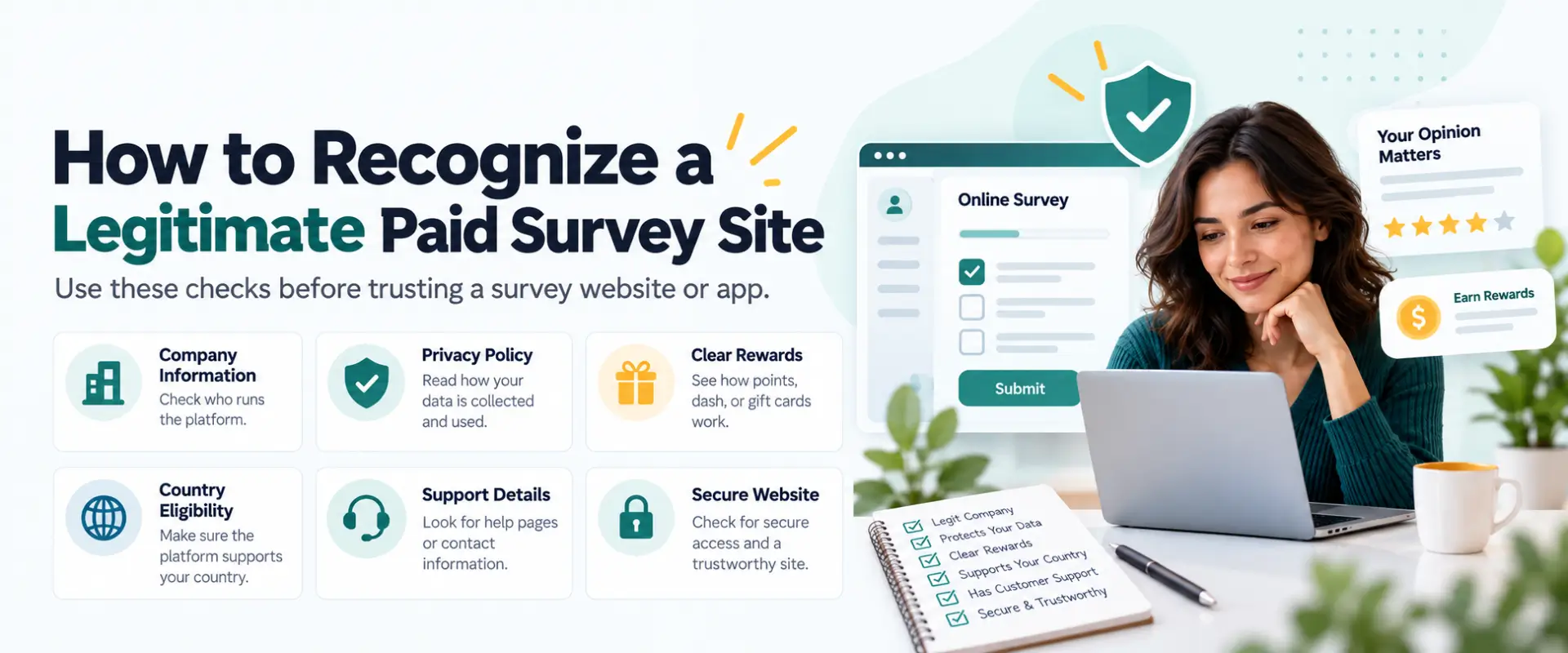
I start with the company name.
I look for an About page, Privacy Policy, Terms, support information, and a reward explanation. If I cannot find the company behind the website, I stop before entering personal details.
Next, I check the payout rules. If a site uses points, I want to know what those points are worth. If it pays cash, I want to know the minimum balance and payment method.
Then I check the country eligibility. Survey access differs by location. A service aimed at US residents might offer different rewards in Canada or the UK.
I also read current help pages. Old reviews often contain outdated thresholds, old screenshots, or reward methods no longer listed.
Last, I search for recent user complaints. I treat reviews as clues, not proof. One complaint tells me little. A pattern of recent complaints about the same unpaid balance gets my attention.
Survey Scam Signs I Take Seriously
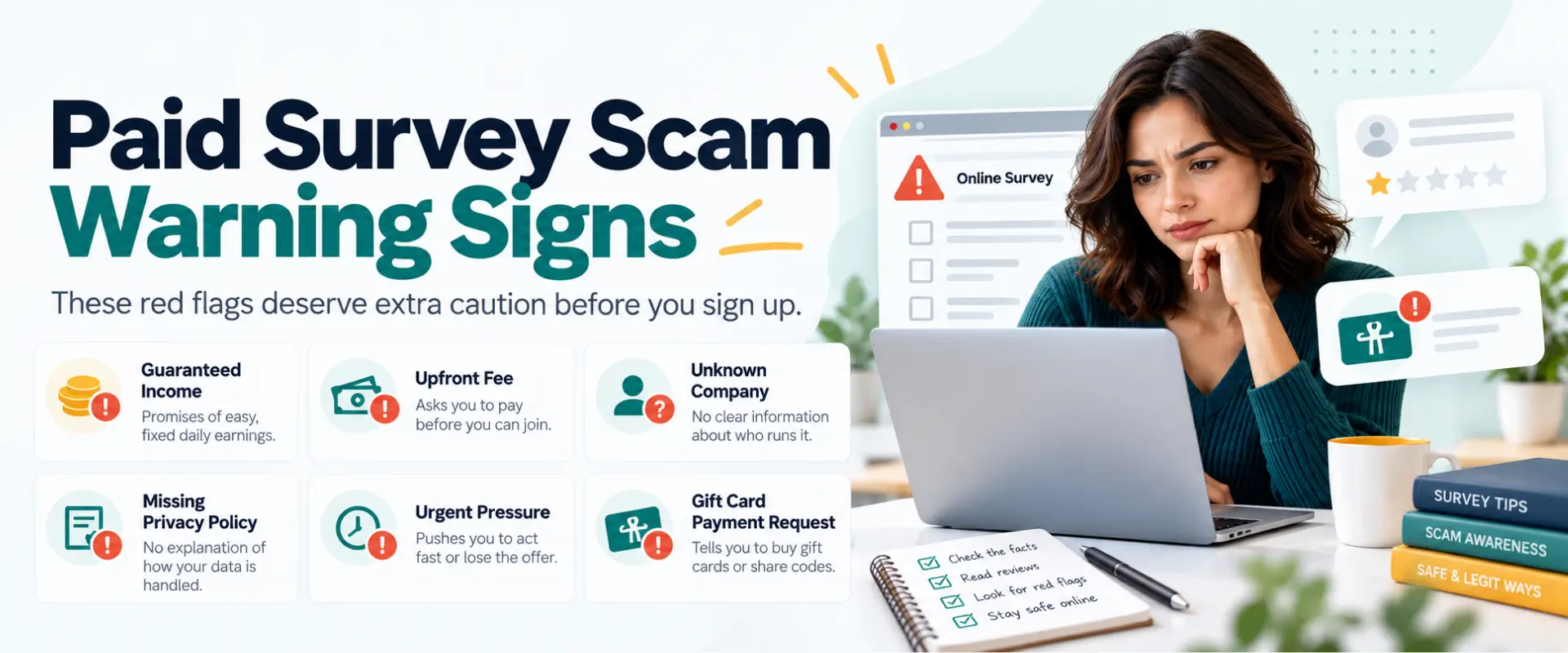
A large upfront fee for access to ordinary surveys makes me cautious. Prolific says participant signup is free, and Ipsos iSay promotes free membership.
Guaranteed income claims are another warning sign. Paid survey access depends on study demand and eligibility. Steady daily income promises do not match how mainstream research panels describe participation.
Unexpected texts deserve extra care.
The US Federal Trade Commission has warned about scam texts pretending to come from familiar companies. Some messages offer a survey or free item, then send people to a link asking for card details or payment. The FTC advises people to avoid links in unexpected texts and contact the company through a website or phone number already known to be genuine.
I would also leave if someone asked me to buy gift cards and send the card number or PIN as payment. The FTC says gift-card payment demands are a scam sign.
What Personal Information Is Normal?
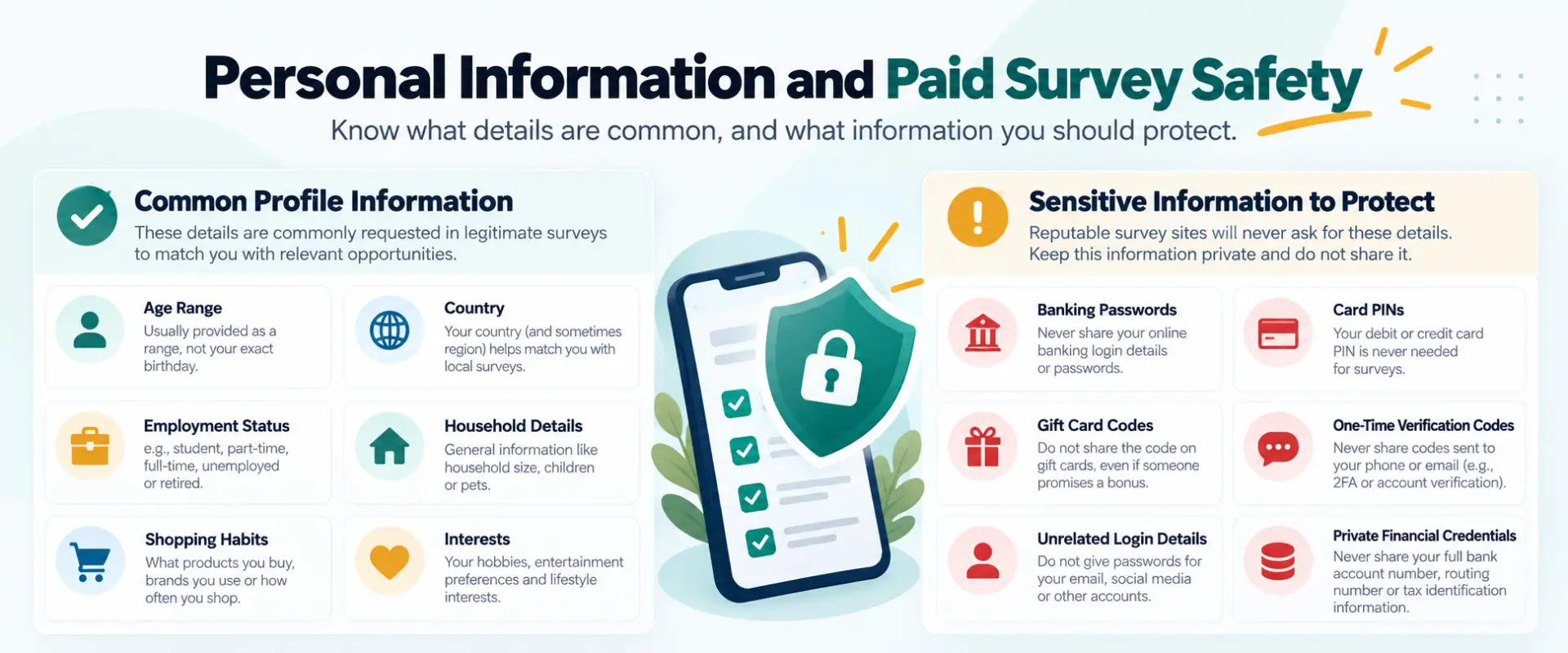
Survey platforms often ask for demographic details because researchers need specific participant groups.
Age range, country, employment, household details, education, shopping habits, device ownership, and interests are common profile topics.
I do not treat every request for personal information as suspicious. Context matters.
For example, Prolific currently asks new participants to complete verification and an About You profile before taking studies. Its guide also describes a waitlist for many new signups.
I draw a firm line around online banking passwords, card PINs, gift-card codes, and unrelated account credentials. A survey company does not need your banking password to send a reward.
Before sharing identity documents, confirm the web address, read the platform’s verification explanation, and check its privacy information. If the reason for a sensitive request feels unclear, stop.
Getting Screened Out Does Not Mean a Site Is Fake
Screening is part of research.
A pet-food study might need dog owners. A banking study might need people who use a specific account type. A product study might already have enough responses from one age group.
If your answers do not fit the study criteria, the survey ends.
What matters to me is how the platform handles screening. I look for clear qualification rules, clear completion rules, and an explanation of any reward offered after a screen-out.
I would not change profile details to fit a survey. Inconsistent answers risk account reviews and poor research data.
Should You Pay to Join a Survey Site?
For ordinary consumer survey panels, an upfront membership fee makes me cautious.
Prolific currently says participant signup is free. Ipsos iSay also promotes free signup.
A paid service is not automatically fraudulent. Some businesses sell research tools, training, memberships, or other services. Those products are different from a consumer survey panel asking for money before giving access to surveys.
If a site asks for payment first, read exactly what you are buying. Do not assume a fee leads to paid survey work.
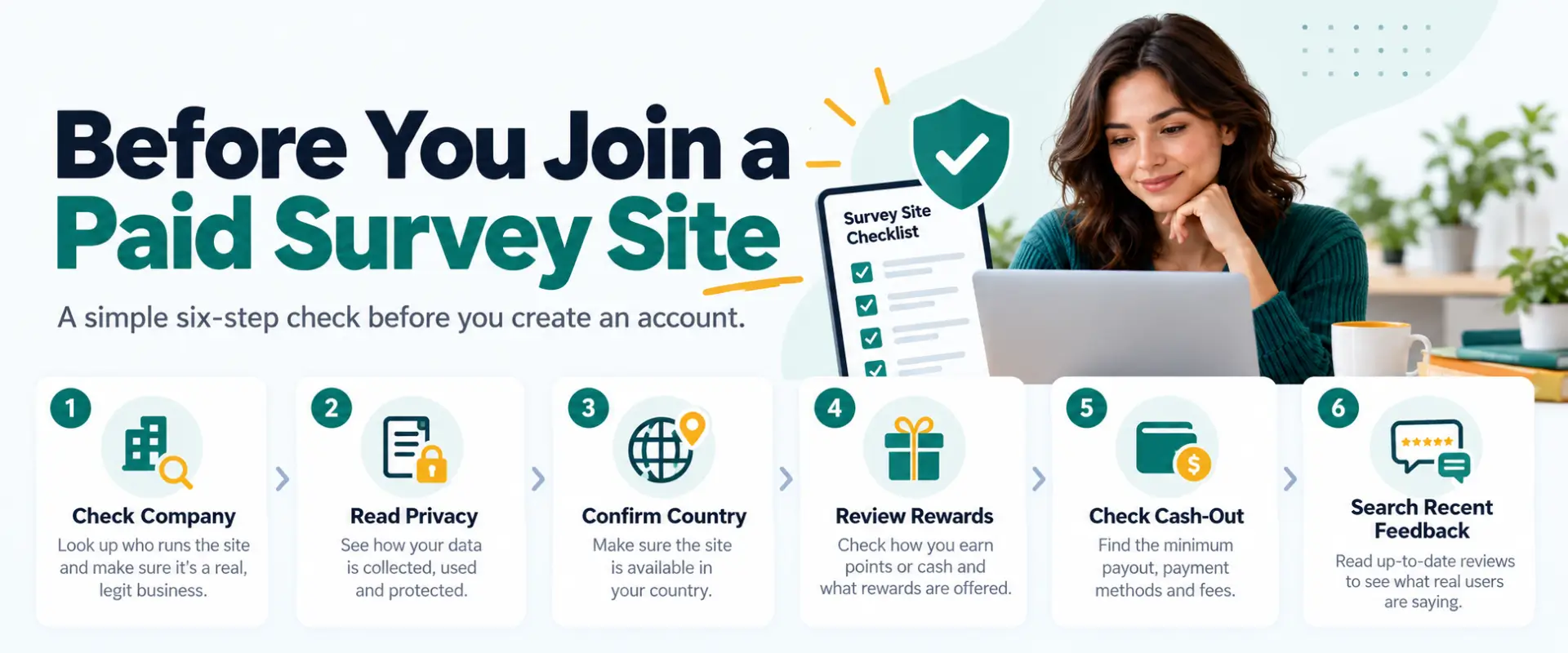
My Six-Step Check Before Joining
I use the same short check whenever I research a new survey platform.
- I searched for the company name and read it’s official About page.
- I open the Privacy Policy and Terms.
- I confirm accepted countries and age rules.
- I find the reward page and write down the minimum cash-out amount.
- I look for a current help center or support page.
- I search recent user feedback and compare repeated issues.
This takes a few minutes. It tells me more than a homepage filled with payment logos and large earnings claims.
Do Legit Survey Sites Pay Real Rewards?
Yes, established platforms publish real reward systems, but each service works differently.
I checked Ipsos iSay’s US rewards catalog while preparing this article. It currently lists gift cards, PayPal funds, Venmo, Virtual Visa prepaid cards, and charity options.
YouGov says members collect points, then exchange an eligible balance for a reward.
Prolific uses a study-based model. Researchers set study rewards, and eligible participants take studies through the platform.
I focus less on reward logos and more on payout rules. Check the threshold, processing terms, supported payment method, and country restrictions before spending much time on a platform.
What I Would Do as a Beginner
I would start with one or two established platforms serving your country.
Complete your profile honestly. Keep a simple note of time spent, completed surveys, screen-outs, and rewards received.
After a week or two, look at your own numbers.
If the time spent feels poor for the reward earned, stop using the platform. If the experience fits your spare time and the reward feels fair, keep it in your rotation.
I would not open ten accounts on the first day. Too many dashboards, emails, profiles, and payout rules make comparison harder.
Are Paid Online Surveys Legit? My Take
Are paid online surveys legit? Yes, established survey and research platforms exist, and some publish clear payment and reward systems. Scams and weak offers also use the same “paid survey” label, so I do not trust a site from its homepage alone.
Check the company. Read the Privacy Policy. Confirm your country. Understand the reward threshold. Search recent feedback. Never send gift-card codes as payment.
For me, “legit” is only the first test.
A platform also needs to fit your profile, location, and time. If the rules feel unclear or the reward process is hard to verify, I would leave and look elsewhere.
At Paid Surveys Club, we plan to use the same process when reviewing survey websites and apps. We will research the rules, try platforms where eligible, record our experience, and report what we found without promising the same result for every reader.