
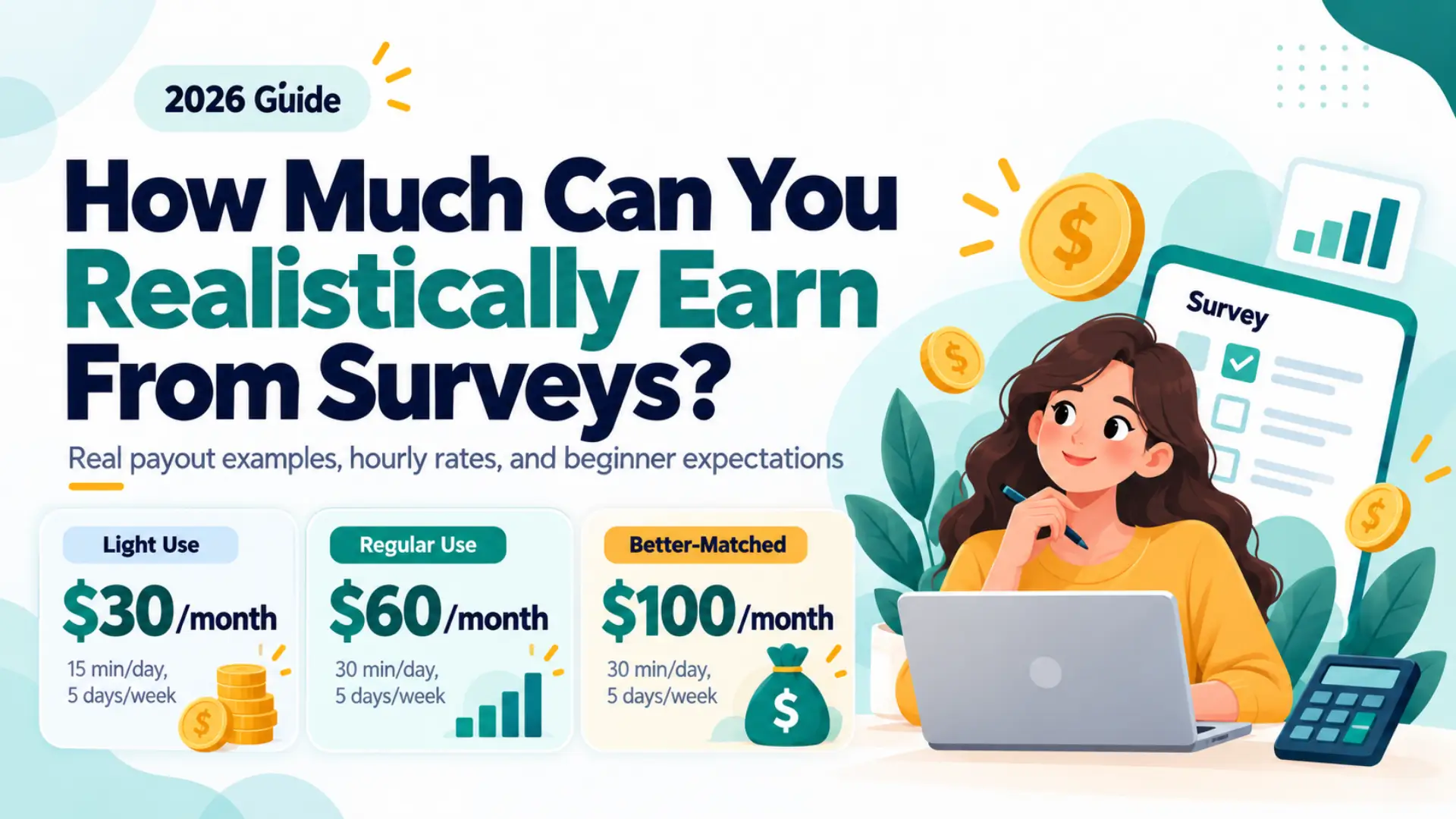
Realistic survey earnings rarely match the large income claims I see in social posts or ads. I checked current payout pages from several established survey and research platforms before writing this guide. The numbers were mixed, which is exactly why I avoid promising one monthly figure for everyone.
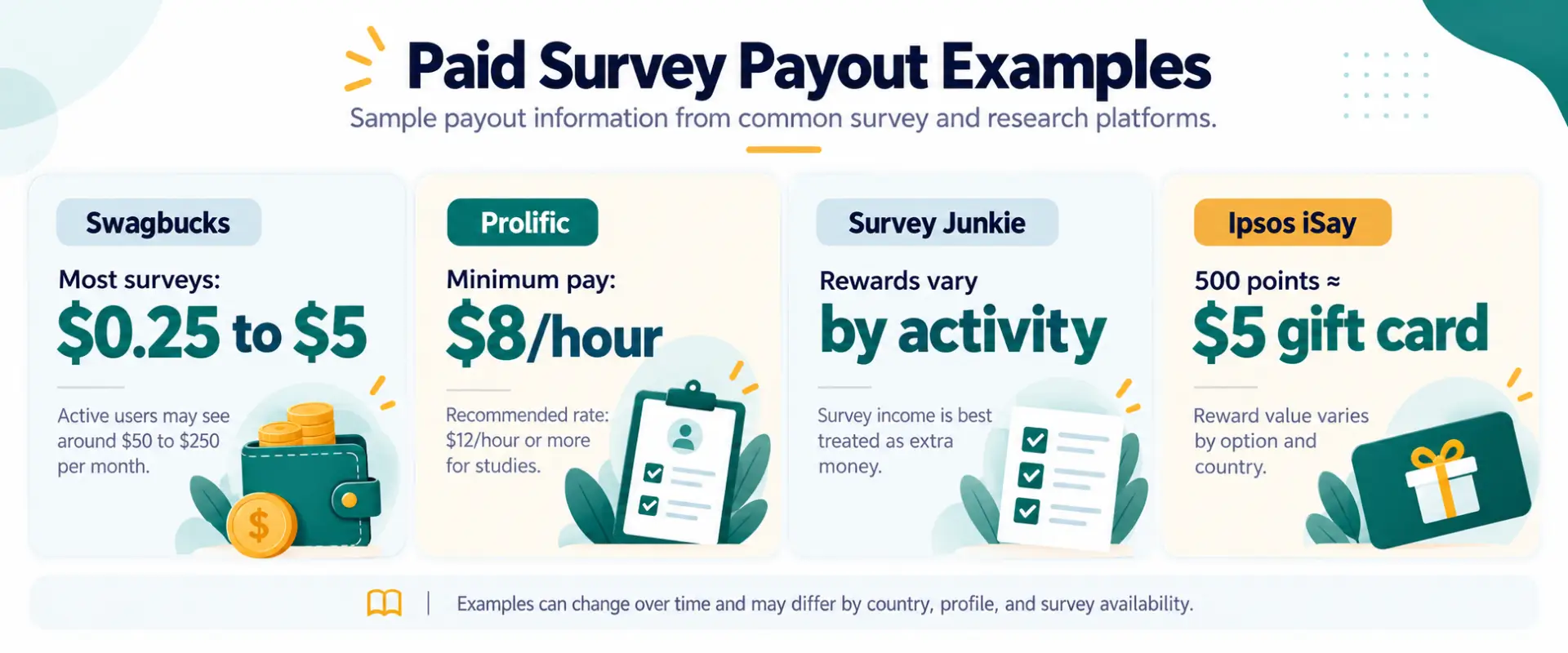
Swagbucks currently says most paid surveys on its platform are worth around $0.25 to $5, with occasional higher-paying opportunities. Its own survey page gives a monthly example of roughly $50 to $250 for active users. Prolific uses a different model. Researchers must meet a minimum reward rate of $8 per hour, and Prolific recommends $12 per hour or more for studies.
Those figures don’t mean you will earn $50, $250, or $12 for every hour you spend looking for studies. Survey supply, screen-outs, your profile, your country, and waiting time all affect your real result.
If you are new to paid surveys, I recommend reading How Do Paid Online Surveys Work? A Beginner’s Guide in 2026 first. If you are still checking whether survey sites are trustworthy, read Are Paid Online Surveys Legit? What Beginners Should Know.
The Short Answer: Survey Income Is Usually Extra Money
I treat paid surveys as extra income, not a salary replacement.
One platform might send several suitable studies in a week. Another might show few matches. Some surveys end after screening. Others pay well for a short study. Your result might look decent one week and weak the next.
Survey Junkie says its service is not meant to replace a full-time job. Prolific also describes participation as occasional research rather than full-time work. Those descriptions fit the way I think beginners should approach survey earnings.
My rule is simple: track your own time and reward total before deciding whether a platform is worth keeping.
What Current Survey Platforms Say About Pay
I prefer current platform pages over old earning screenshots. Screenshots often leave out time spent, failed screening attempts, bonuses, referrals, or country differences.
Swagbucks
Swagbucks says most paid surveys are worth about $0.25 to 5. Some longer or specialized surveys pay more. It’s current survey page also gives an example range of 50 to $250 per month for active users. I read this as a platform estimate, not a personal income promise.
Prolific
Prolific looks different from many consumer survey panels. Its current researcher rules set an 8 per hour minimum for participant rewards and recommend at least 12 per hour. Prolific calculates hourly reward from study completion time, which gives participants a clearer view of study value.
This still does not mean every hour logged into Prolific produces paid work. Available studies depend on researcher demand and participant eligibility.
Survey Junkie
Survey Junkie states earnings depend on time spent, participation method, and personal earning goals. It also says survey income is not intended to replace a full-time job. Its current US information lists a $5 redemption level, equal to 500 points.
Ipsos iSay
I checked the current US Ipsos iSay rewards catalog. At the time of review, 500 points matched several $5 gift-card options. A $5 PayPal reward was listed at 525 points. Reward values differ by option and country, so I check the live catalog before judging how far the points go.
I checked these source pages on October 5, 2026. Current platform pages matter more to me than old payout screenshots.
Per-Survey Pay Tells Only Part of the Story
A $3 survey sounds better than a $1 survey until time enters the calculation.
For me, effective hourly rate is more useful than the reward shown on one survey card.
“A high payout means little if unpaid time around it is large.”
Use this formula:
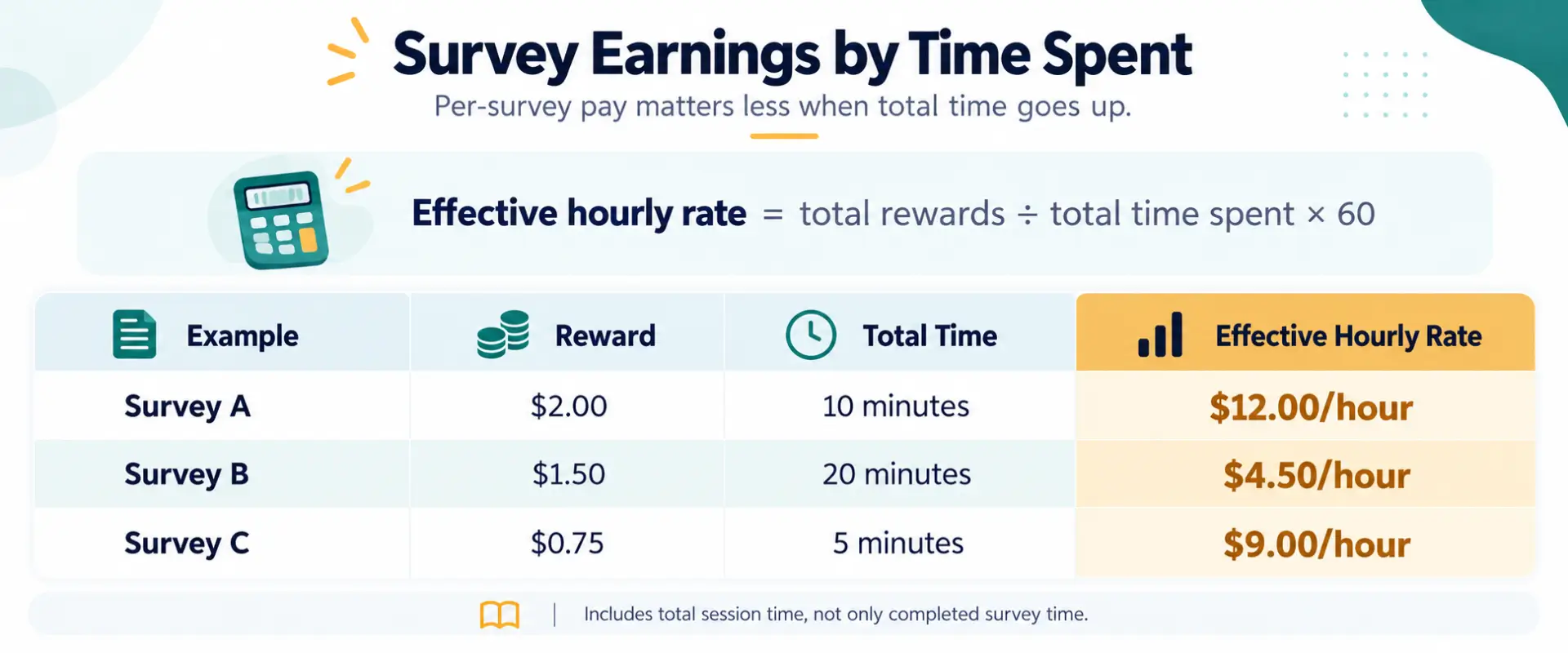
Effective hourly rate = total rewards ÷ total time spent × 60
The time total should include more than completed surveys. I also count screening time, loading pages, looking for suitable studies, and abandoned surveys.
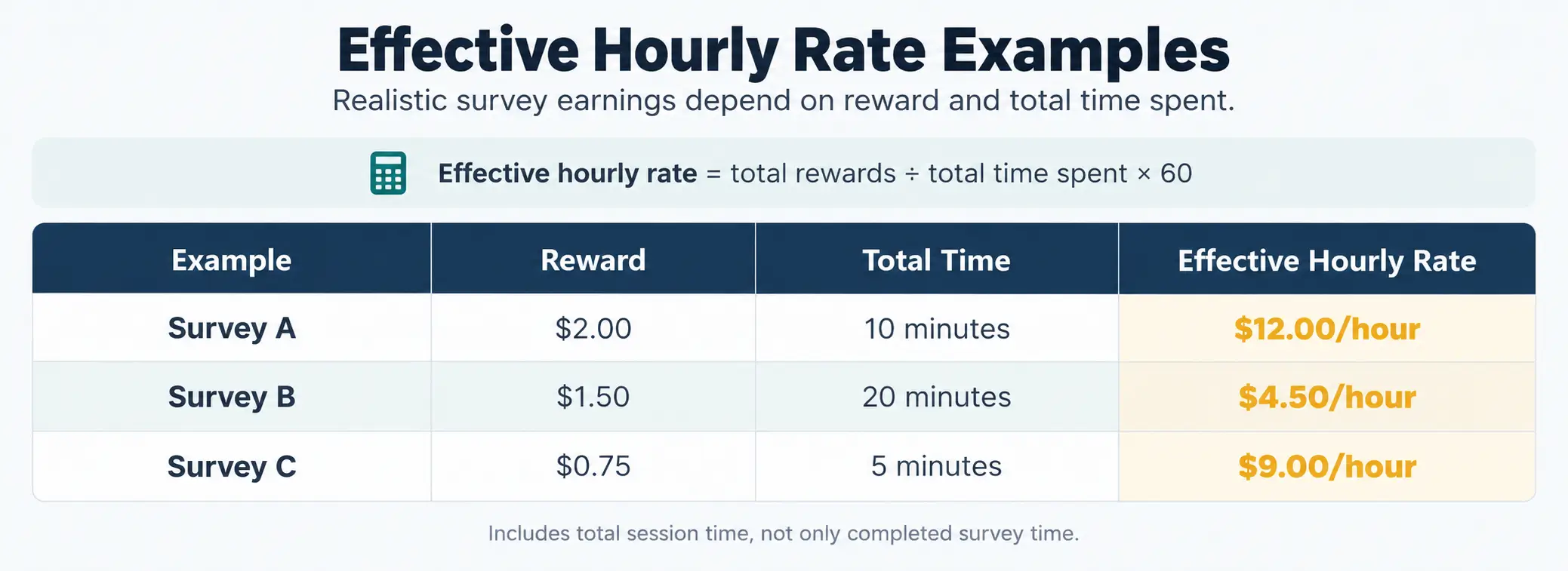
Survey B looks decent at first. Once I include 20 minutes of total time, its value drops. One payout number is not enough for me.
Three Monthly Earning Examples
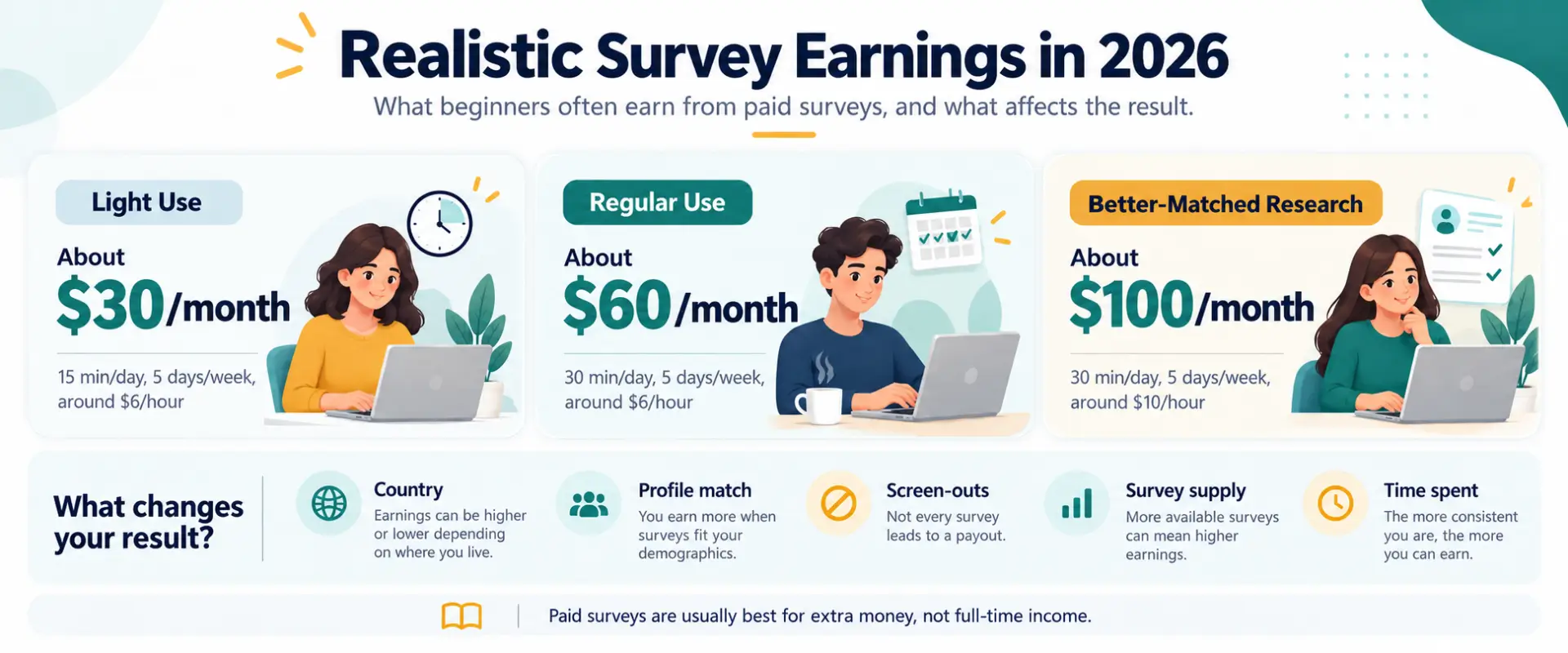
These are math examples, not expected earnings. I use them to show how time and hourly value change a monthly total.
Example 1: Light Use
You spend about 15 minutes per day on surveys, five days per week. Your tracked effective rate averages $6 per hour.
The result is roughly $30 over four weeks.
Example 2: Regular Use
You spend about 30 minutes per day, five days per week. Your tracked effective rate averages $6 per hour.
The four-week total is roughly $60.
Example 3: Better-Matched Research
You spend about 30 minutes per day, five days per week. Your tracked effective rate averages $10 per hour.
The four-week total is roughly $100.
These examples assume enough suitable studies exist. Real weeks often include gaps, screen-outs, and days with no worthwhile survey.
Why Two People Earn Different Amounts
I expect two members on the same platform to report different results. Survey matching depends on several factors.
1. Country
Research demand differs by region. A US member might see a different survey supply from someone in Canada, the UK, or another supported country. Reward methods also vary by region.
2. Age and Household Profile
Researchers often need a narrow participant group. A study might seek parents of young children, recent car buyers, streaming subscribers, business owners, or people using a certain type of phone.
3. Work and Shopping Habits
Your occupation, industry, purchases, subscriptions, and household decisions influence matching. One profile might fit several active studies while another profile fits none.
4. Screen-Out Rate
Screening has a direct effect on your hourly result. Ten minutes spent across failed qualification attempts still uses your time, even when the reward total stays at zero.
5. Survey Supply
Study volume changes. Researchers fill quotas. Some invitations disappear quickly. A fixed budget built around a daily survey count looks risky to me.
6. Reward Type and Cash-Out Rules
Points are easy to misread. I always convert points into a cash or gift-card value before spending much time on a platform.
For more platform-specific information, visit our Survey Sites & Apps page.
The Biggest Earnings Leak: Unpaid Time
The part beginners often miss is unpaid time.
A survey paying $2 for ten minutes looks like a $12 hourly rate. If you spend another ten minutes across two failed screeners before finding it, your real rate across the full session drops to $6 per hour.
This is why a high survey reward does not always produce a high session reward.
When I review a platform, I track these four numbers:
- ✓ Minutes spent looking for surveys
- ✓ Minutes spent on screeners
- ✓ Minutes spent on completed surveys
- ✓ Rewards credited
After a week, divide total rewards by total time. Your own data gives a stronger answer than a promotional earning claim.
How I Track Survey Earnings for 7 Days
A simple note or spreadsheet is enough. I record every session, including failed attempts.
- Write the date.
- Write the platform name.
- Record total minutes spent.
- Record completed surveys.
- Record screen-outs.
- Record rewards credited.
- Calculate your effective hourly rate at the end of the week.
💡 Example: You spent 180 minutes across one week and earned $18. Three hours of total time for $18 gives an effective rate of $6 per hour.
If another platform gives you $12 from one hour of total effort, I spend more time there and less time on the weaker platform.
How to Improve Your Survey Earnings Without Gaming the System
My focus stays on time quality rather than chasing every invitation.
- Complete your profile honestly. Better profile data helps survey matching.
- Keep profile answers consistent. Changing basic facts to qualify for more studies risks account problems and weak research data.
- Check reward and estimated time first. A long survey with a small reward often has poor value.
- Use the required device. Some studies work only on mobile or desktop.
- Turn on legitimate platform notifications. Faster access matters when quotas fill quickly.
- Cash out after reaching a comfortable threshold. I prefer keeping less value sitting in a rewards account.
- Review your weekly hourly rate. Drop platforms which consistently waste your time.
Our Survey Tips page covers more practical ways to manage survey time and participation.
Should You Join Several Survey Sites?
I start with two or three established platforms, not ten.
Too many accounts create more email, more profiles, more reward rules, and more balances below cash-out thresholds. A smaller group makes comparison easier.
Use each platform long enough to collect useful data. Seven to fourteen days gives you a better sample than one afternoon.
Afterwards, keep the platforms with better matching and fairer time value. Leave the weak ones.
Is $500 Per Month From Surveys Realistic?
I treat $500 per month as an aggressive target for ordinary survey use.
Swagbucks currently gives $50 to $250 per month as an example range on its survey page. Other research platforms use different reward systems, and some studies pay a stronger hourly rate. Still, survey supply is uneven, and qualification limits how much paid work reaches one person.
Someone might reach $500 during an unusually strong month across several sources, higher-paying research, product studies, or bonuses. I do not use $500 as a beginner expectation.
What About $1,000 Per Month?
I view $1,000 from ordinary online surveys as exceptional rather than realistic for most beginners.
At an effective $8 per hour, reaching $1,000 requires 125 paid hours. A survey account rarely offers a steady 125 hours of suitable, paid work in one month.
Higher-paying interviews, focus groups, product studies, or specialist research sit in a different category from routine survey panels. Mixing those earnings together often makes survey income screenshots look stronger than ordinary survey results.
When Surveys Feel Worth It
For me, surveys make the most sense when the time would otherwise be unused and the reward is clear.
A short study during spare time might feel worthwhile. A 25-minute survey paying $0.50 would not interest me.
I also look at payout friction. A platform feels less useful when it takes months to reach a withdrawal threshold.
“Worth it” depends on your own time value, country, survey supply, and preferred reward. I measure it instead of guessing.
When I Stop Using a Survey Platform
I leave or reduce time on a platform after seeing a repeated pattern like this:
- ✕ Frequent long screeners with no reward
- ✕ Low-paying surveys taking much longer than listed
- ✕ A reward threshold which feels difficult to reach
- ✕ Few surveys matching my profile
- ✕ Unclear payout rules
- ✕ Repeated technical failures during completion
A legitimate site still might be a poor use of your time. I separate trust from value.
Frequently Asked Questions
How much does one paid survey pay?
There is no fixed amount. Swagbucks currently says most surveys on its platform pay around $0.25 to $5, while specialized opportunities sometimes pay more. Other platforms use different reward models.
How many paid surveys should I expect each day?
I do not set a fixed number. Availability depends on your profile, country, researcher demand, and open quotas. Some days might show several matches. Other days might show none worth taking.
Do survey sites pay cash or gift cards?
Both are common. Depending on the platform and country, rewards include PayPal, bank transfer, prepaid cards, retailer gift cards, or points exchanged for rewards.
Are high-paying surveys always better?
No. I compare reward with total time. A lower-paying five-minute survey might beat a higher-paying survey taking 30 minutes plus screening time.
Should I count screen-out time?
Yes. I count it when measuring my personal hourly result. Unpaid screening still uses time.
Are paid surveys worth doing in 2026?
For extra money during spare time, they might fit. I would not rely on surveys for fixed bills or guaranteed monthly income. Your own seven-day tracking record will tell you more than an income screenshot.
My Realistic Expectation for a Beginner
If I were starting today, I would join two or three established platforms, complete each profile honestly, and track every minute for one week.
I would skip a large monthly target at the start. First, I would learn my own effective hourly rate.
If one platform gave me $6 to $10 per hour across total tracked time, I would keep it for spare-time use. If another platform kept me near $2 or $3 per hour after screen-outs, I would spend less time there.
Realistic survey earnings come from your own completed studies, screen-out rate, location, profile, and time spent. Platform averages help with context. Your personal tracking tells you whether the effort is worth it.
Start with realistic expectations, keep your answers honest, and measure the numbers. For beginners, paid surveys make more sense as flexible extra income than a dependable monthly paycheck.