
Paid survey payments usually arrive as cash, points, gift cards, or prepaid rewards. When I first looked at survey reward systems, the payment part seemed simple. Finish surveys, earn something, withdraw it.
After looking closer, I found more details worth checking.
A site might show 2,000 points without making the cash value obvious. Another might display a dollar balance but require you to reach a minimum amount before requesting payment. Gift cards sometimes need fewer points than cash rewards.
Those details affect what your survey time is worth.
This guide explains how paid survey payments work, what points mean, how gift cards differ from cash, and what I check before requesting a payout.
If you are still learning how surveys work, read our beginner guide to paid online surveys first.
If you want a clearer idea of expected earnings, read our realistic survey earnings guide.
How Paid Survey Payments Work
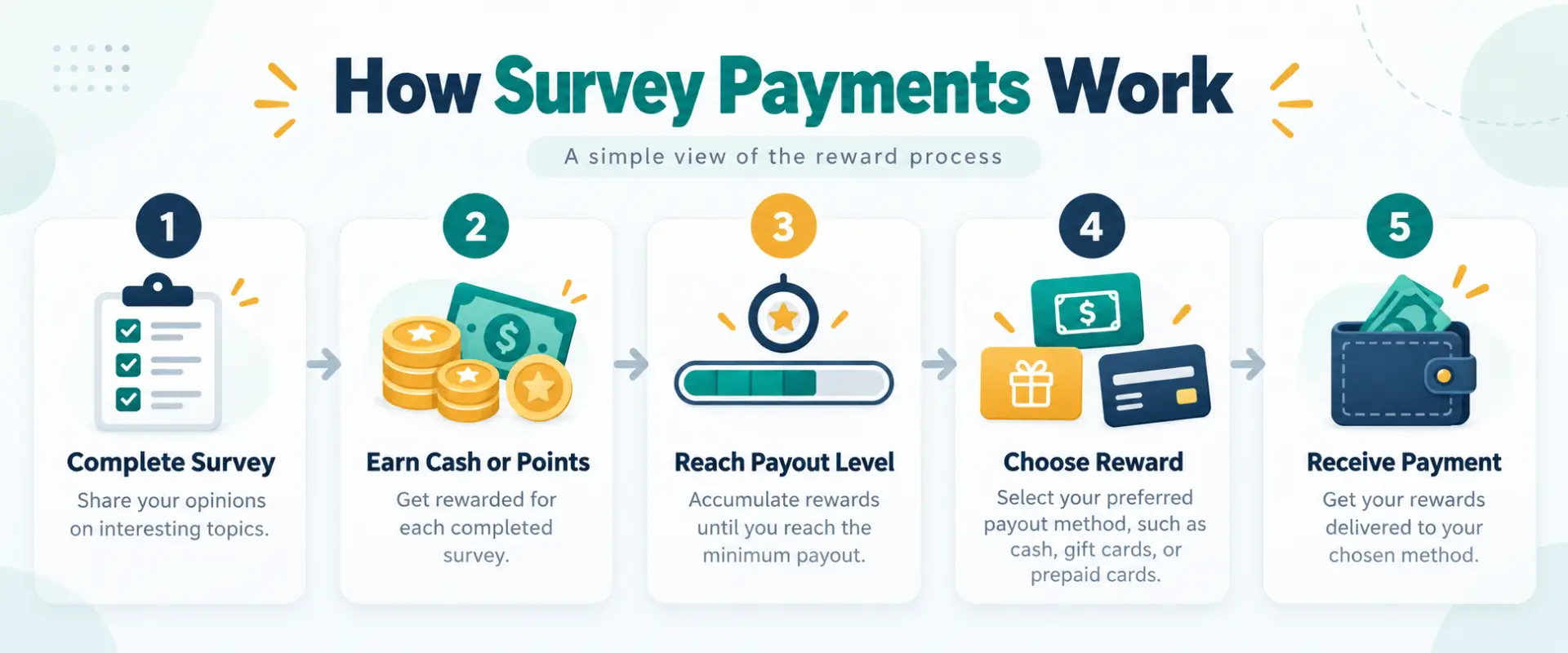
Most survey reward systems follow a similar process.
- You complete an eligible survey.
- The survey company reviews or records the completion.
- Your account receives cash, points, or another reward balance.
- You reach the required redemption amount.
- You select an available payment method.
- The reward is sent to your payment account, email, or reward dashboard.
The important part for me is step four.
Earning a reward and receiving a reward are separate events.
For example, your account might show $3.80 after several surveys, while the withdrawal threshold sits at $5. You have earned the $3.80 inside the account, yet you still need another $1.20 before requesting payment.
Points work the same way.
You might see 800 points in your account. Until you know how many points equal $1, $5, or $10, the number does not tell you much about the reward value.
I focus on redemption value rather than the size of the point balance.
1. Cash Payments
Cash is the payment method I find easiest to understand.
If a survey account shows $7.50, I immediately know the stated value. There is no point conversion to calculate first.
Survey sites use several cash payment methods depending on the country and platform.
Common options include:
- PayPal
- Bank transfer
- Digital payment services
- Direct cash balance withdrawals
Availability differs between countries. The payment method shown during registration also might change later, so I check the reward page again before spending much time completing surveys
PayPal Payments
PayPal appears frequently as a survey payment option.
I like this type of payout because the value is easy to understand. A $10 PayPal reward means I am comparing a dollar amount rather than converting hundreds or thousands of points.
There are still a few details I check:
- The minimum payout amount
- The email address connected to the payment account
- Whether identity verification is required
- The stated processing period
- Currency conversion
- Any listed fees
Currency deserves extra attention if the survey reward arrives in a different currency from the one you normally use.
A $10 payout and the final amount available after currency conversion are not always identical.
Bank Transfer Payments
Some survey and research services offer direct bank payments.
This payment route interests me because the money moves toward an account I already use.
I still look at the minimum withdrawal amount and expected processing period first.
Bank availability often depends on where you live. A payment option offered in the United States might not appear for someone joining from Canada, the United Kingdom, Australia, or another supported country.
Always judge the payment options shown inside your own account.
Screenshots from another member might show a different reward menu.
2. Survey Points Explained
Points are where survey payments become less obvious.
A site might award:
- 50 points for one survey
- 120 points for another
- 800 points after several completed surveys
Those figures look meaningful, but I do not compare them until I know the redemption rate.
Suppose a fictional survey site uses this reward system:
1,000 points = $10
The calculation becomes:
$10 ÷ 1,000 points = $0.01 per point
A 100-point survey would then have a stated reward value of $1.
Now consider another fictional site:
2,000 points = $10
A 100-point survey there equals only $0.50.
The second platform uses a larger point number, yet the reward value is lower.
That is why I do not treat point totals as earnings until I convert them.
How I Calculate Survey Point Value
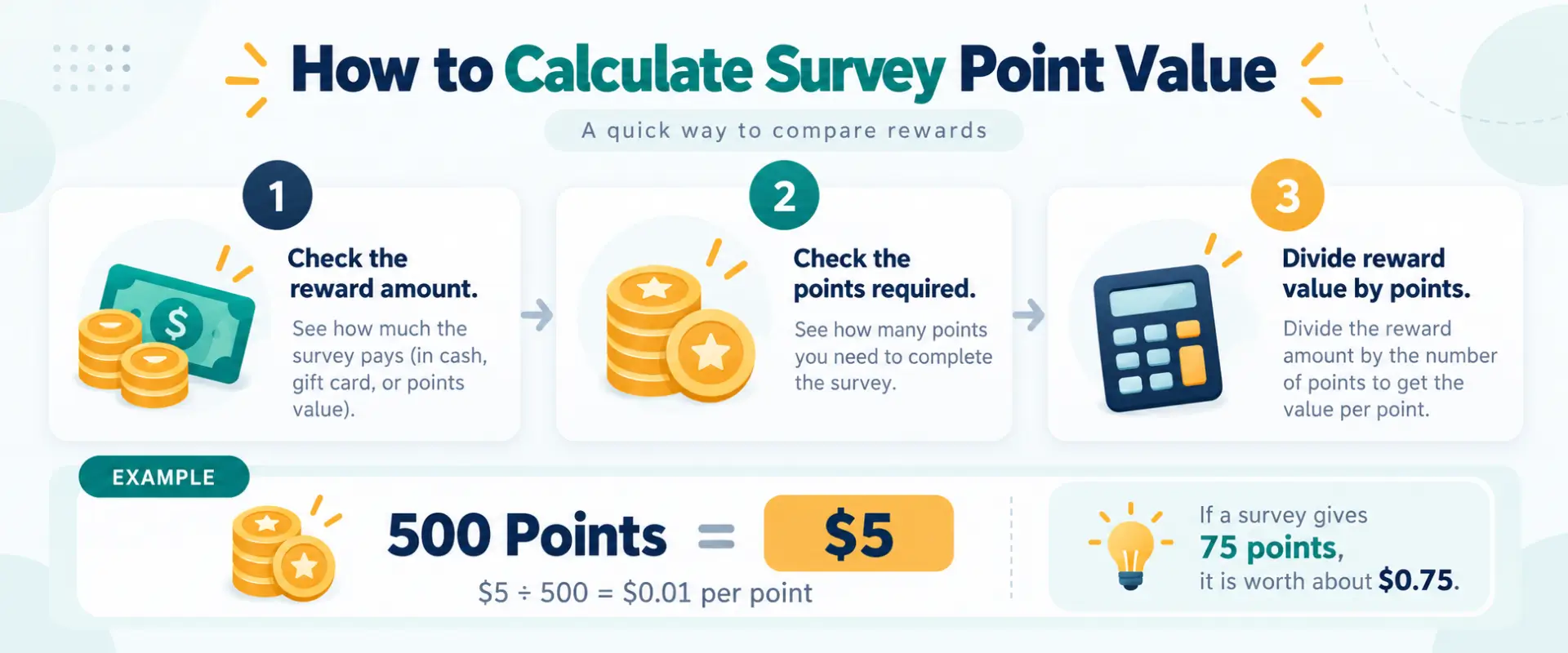
I use this formula:
Reward value ÷ points required = value of one point
Here is another example.
A $5 reward requires 500 points.
$5 ÷ 500 = $0.01 per point
A 75-point survey would therefore have a reward value of about $0.75.
Doing this once makes future survey offers much easier to judge.
Different Rewards Might Have Different Point Values
This detail is easy to miss.
Suppose a reward page lists:
- 500 points for a $5 store gift card
- 550 points for a $5 cash reward
Both rewards show a $5 face value.
The gift card requires fewer points.
If I already planned to shop at the listed store, I would take the difference seriously. If I had no use for the store, cash would still hold more practical value for me.
The highest dollar label is not the only number worth checking.
Look at the points required to receive it.
3. Gift Card Payments
Gift cards are another common survey reward.
Instead of receiving money in a payment account, you receive credit linked to a retailer or service.
Examples often include cards for:
- Online retailers
- Grocery stores
- Restaurants
- Entertainment services
- App stores
- General shopping retailers
I judge a gift card based on where I already spend money.
A $10 card for a retailer I use every month has close to $10 of practical value for me.
A $10 card for a retailer I never visit has much less personal value.
That difference matters when choosing between cash and gift cards.
Digital Gift Cards
Many survey gift cards are delivered digitally.
You might receive:
- An email containing the reward
- A redemption code
- A link to a reward portal
- A digital card number
I save the reward email until the balance is fully used.
I also check:
- Expiration information
- Activation deadlines
- Retailer restrictions
- Minimum purchase requirements
- Remaining balance rules
These terms differ between gift card issuers.
When I Would Choose a Gift Card
I would consider a gift card when:
- ✓ I already shop with the retailer.
- ✓ The reward requires fewer points than cash.
- ✓ The minimum redemption amount is lower.
- ✓ I have a planned purchase.
I would avoid choosing one only because the reward looks attractive.
If I spend extra money simply to use a gift card, the survey reward becomes less useful.
4. Prepaid Cards
Some reward programs offer prepaid digital cards instead of retailer-specific gift cards.
A prepaid card usually offers more spending choice than a card tied to one store.
Before selecting one, I check:
- Expiration date
- Activation requirements
- Merchant restrictions
- International purchase rules
- Online purchase support
- Remaining balance rules
Small leftover balances sometimes become inconvenient.
For example, imagine a prepaid card has $1.73 remaining. Some checkout systems accept split payments. Others do not.
I would rather understand this before choosing the reward.
Cash vs Points vs Gift Cards
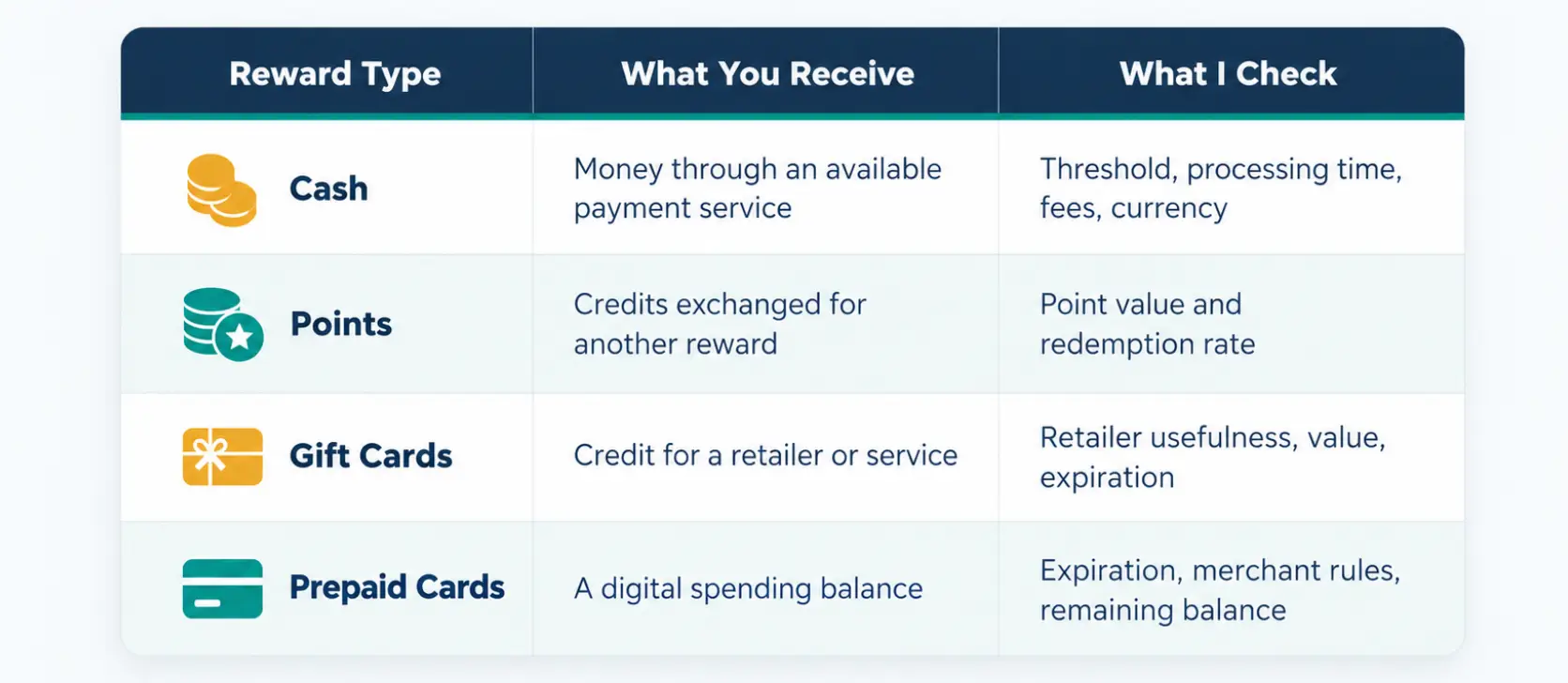
I usually prefer cash when the redemption value is similar.
Cash gives me more choice over where the money goes.
A gift card becomes more interesting when I already planned to spend money at the retailer and the point conversion is better.
Minimum Payout Thresholds Matter
The minimum payout threshold is the amount you need before requesting a reward.
I pay close attention to it.
Consider two fictional survey accounts.
Site A: $5 minimum payout
Site B: $20 minimum payout
Suppose you earn an average of $2 each week on either site.
At the same pace:
- Site A takes roughly 2.5 weeks to reach $5.
- Site B takes roughly 10 weeks to reach $20.
The earnings rate in this example is identical.
The waiting period is different.
I prefer reaching my first redemption sooner because it lets me see how the payment process works before building a larger account balance.
Do Not Judge a Survey by the Reward Amount Alone
A $3 survey does not automatically give better value than a $1 survey.
Time matters.
Suppose I see these two fictional offers:
Survey A:
$3 reward
45 minutes
Survey B:
$1 reward
10 minutes
Survey A pays about $4 per hour based on the listed completion time.
Survey B works out to about $6 per hour.
The smaller survey reward gives the better hourly rate in this example.
Screening time matters too.
I wrote more about this in our guide to realistic paid survey earnings.
I track the whole session when I want a useful earnings estimate, including unsuccessful screeners.
Payment Processing Time
A successful redemption does not always mean the reward arrives at the same moment.
Processing depends on the reward system.
Some payments arrive quickly. Others go through review or verification first.
I keep the redemption confirmation until the money or gift card arrives.
For my own tracking, I record:
- Date requested
- Reward type
- Amount requested
- Date received
- Fees or conversion differences
After several payments, this gives me a useful record of how the platform handles rewards.
Account Verification Before Payment
Some survey services ask members to verify account information before withdrawal.
Verification might involve:
- Email confirmation
- Phone verification
- Name matching
- Address information
- Identity checks
I prefer to read the withdrawal requirements early.
Finding a verification problem after reaching the payment threshold wastes time.
Your account details should also stay consistent.
Using different names, locations, or payment details might lead to additional review.
Gift Card Rewards and Gift Card Scams Are Different
There is an important difference between receiving a gift card as a survey reward and someone asking you to purchase a gift card as payment.
A survey reward works like this:
You complete eligible survey activity → the company sends a reward to you.
A suspicious request looks different:
Someone asks you to buy a gift card → they ask for the card number or PIN.
The Federal Trade Commission warns people against paying someone through gift cards or sharing gift card numbers with unexpected callers or messages.
If a supposed survey company asks you to buy gift cards before receiving earnings, I would stop.
For more checks before joining a survey service, read our guide to legitimate paid online surveys.
I follow the same basic list before redeeming a reward.
- Check the minimum payout.
I make sure my available balance has reached the redemption level. - Check pending rewards.
A pending survey reward is different from an available balance. - Convert points into money.
I calculate the real value before choosing a reward. - Compare cash and gift cards.
Different redemption choices sometimes require different point totals. - Check fees.
I look for withdrawal or currency conversion costs. - Confirm account information.
I check the name, email, country, and payment details. - Save the confirmation.
I keep a screenshot or email until the reward arrives. - Record the delivery time.
I note how long the payout takes from request to receipt.
A Simple Payment Example
Suppose I spend one week using a survey site.
My results look like this:
- Surveys completed: 8
- Total points earned: 720
- Reward threshold: 500 points
- 500 points = $5
I have enough for one $5 reward.
The remaining 220 points stay in the account.
Now suppose the reward menu offers:
- 5giftcard=500points
- 5 cash = 550 points
I would compare both choices.
If I already need something from the gift card retailer, 500 points gives me the same stated dollar amount for fewer points.
If I prefer unrestricted spending, I might wait until 550 points and choose cash.
This is why I compare redemption value instead of selecting the first reward I see.
Frequently Asked Questions About Paid Survey Payments
Do paid surveys pay real money?
Some survey services offer cash rewards. Others use points first, then let members exchange those points for cash, gift cards, prepaid cards, or other listed rewards.
Check the payment section before joining.
Are survey points the same as cash?
No. Points are a reward unit used inside a platform.
Their value depends on the redemption rate.
If 500 points equals a $5 reward, each point is worth $0.01 for that specific redemption.
Which is better, cash or gift cards?
I prefer cash when the value is similar because it gives me more spending choice.
I would choose a gift card when I already use the retailer and the redemption rate gives better value.
Why is my survey reward pending?
Some surveys require review before the reward becomes available.
A pending amount should not be treated as withdrawable money until it moves into your available balance.
Should I save points for a larger reward?
I usually prefer making a smaller first redemption once I reach a useful threshold.
It lets me check the payment process without leaving a large reward balance inside the account.
After I see how payment works, I decide whether saving for a larger reward makes sense.
Are gift card survey rewards safe?
A legitimate gift card reward is sent to you after eligible activity.
Be cautious if someone asks you to buy a gift card, send money, or provide a gift card PIN before releasing supposed survey earnings.
What I Look for in Paid Survey Payments
Paid survey payments make more sense when I reduce them to a few numbers.
I look at:
- Survey reward
- Time required
- Point conversion
- Minimum payout
- Payment method
- Fees
- Processing time
Cash is easier to value.
Points require a little math.
Gift cards make sense when they match purchases you already planned.
Prepaid cards offer broader spending options, though their terms still deserve a look.
I would start with a small redemption rather than letting a balance build for months.
Then I would record what I requested, when I requested it, and what arrived.
After a few payouts, your own payment history gives you a much clearer picture of whether the survey site is worth your time.