
Do paid surveys really pay? Yes. Real people get real money from them every day. But the amount is small, and it’s smaller than most ads make it sound.
I’d rather you hear that now than after a week of chasing a payout. So this guide covers the actual numbers, what quietly eats into your earnings, and who comes out ahead.
📌 Quick answer: Yes, paid surveys really pay, but most people land around $1 to $5 per hour once screen-outs and search time are counted. Think of it as pocket money for spare minutes, not a replacement for a paycheck.
Do paid surveys really pay real money?
Yes, and the reason is simple. Companies want to know what ordinary people think about their products, ads, and apps. Market research firms collect those opinions, and survey sites get paid to deliver the people who give them. A slice of that money comes back to you as cash, points, or gift cards. Our guide on how paid online surveys work walks through the whole chain.
So the money is real. The catch is how the slice is cut. You only get paid for a completed survey. Get screened out two minutes in, and the clock kept running while the meter stayed at zero. That one detail explains most of the gap between what people expect and what they get.
How much do paid surveys pay per survey and per hour?
Most well-known survey sites pay about $0.50 to $3 for a typical survey that takes 5 to 20 minutes. Do the math and you end up at $1 to $5 an hour, which is the range published reviews keep arriving at. The Better Business Bureau has said the same thing in plainer words: don’t expect to get rich, because most surveys pay a few dollars an hour.
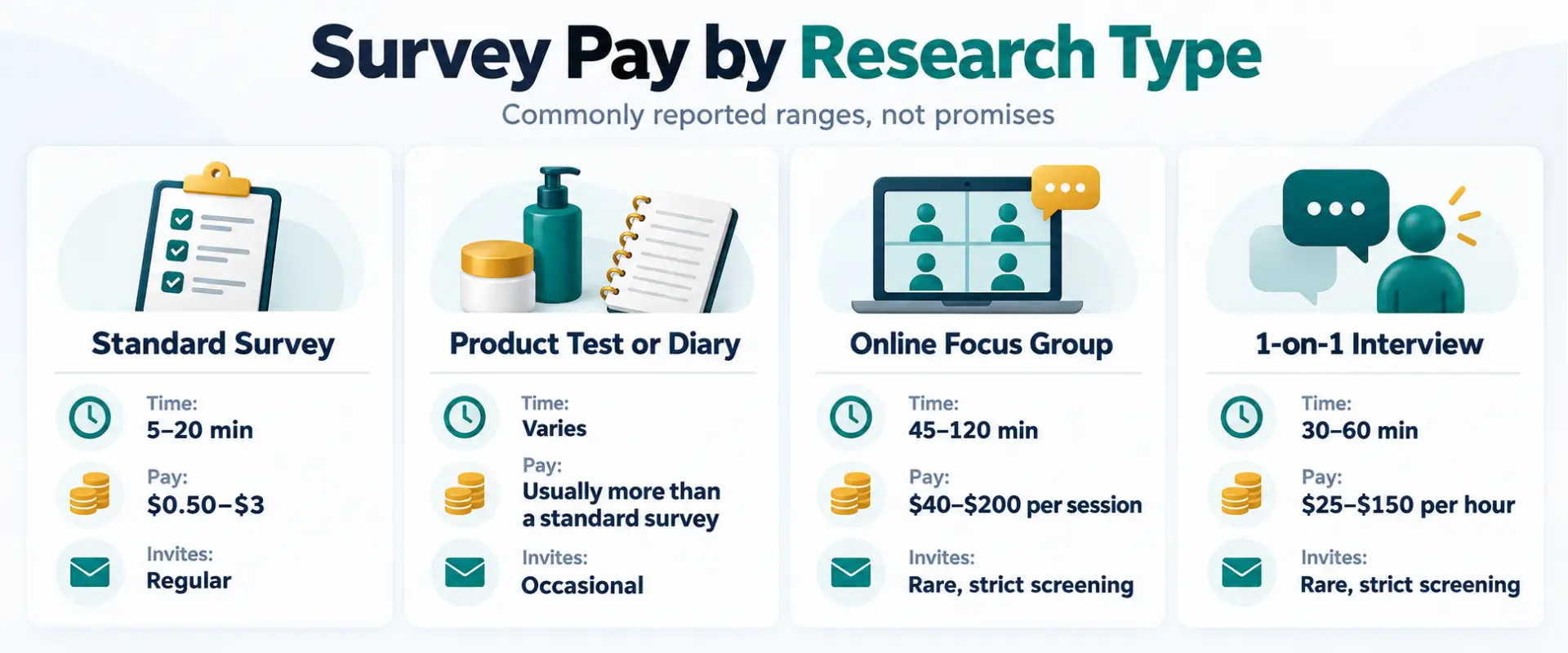
Other kinds of paid research pay more, but they’re harder to get into. Here’s the rough picture:
| Type of paid research | Typical time | Commonly reported pay | How often you’ll see invites |
| Standard online survey | 5 – 20 minutes | $0.50 – $3 per survey | Regularly |
| Product test or diary study | Varies | Usually more than a standard survey | Occasionally |
| Online focus group | 45 – 120 minutes | Often $40 – $200 per session | Rarely, strict screening |
| One-on-one research interview | 30 – 60 minutes | Commonly $25 – $150 per hour | Rarely, strict screening |
Why your real hourly rate is lower than the advertised one
A survey that says “$1.50 for 15 minutes” looks like $6 an hour. On paper, it is. In practice, almost nobody gets paid for every minute they spend, for three reasons:
- Screeners. Many surveys open with a few questions and then end with “Sorry, you don’t qualify.”
- Full quotas. You click an invite and the study has already closed.
- Unpaid admin. Hunting for open surveys and filling out profile questions pays nothing.
Here’s what that does to the numbers. These are made-up examples with round figures, meant to show the pattern rather than the rates of any one site:
| Example survey | Hourly rate on paper | Minutes lost per hour | Surveys finished | Real hourly pay |
| $1.00 for 10 minutes | $6.00 | 15 | 4 | $4.00 |
| $0.40 for 5 minutes | $4.80 | 20 | 8 | $3.20 |
| $2.50 for 25 minutes | $6.00 | 10 | 2 | $5.00 |
Even in these tidy examples, a $6 hour turns into a $3 to $5 hour. A rough hour, say three screen-outs in a row and one closed study, can land close to zero. That’s why so many people who actually track their time report $1 to $3.
A rule of thumb I’d suggest: treat about 10 cents a minute as a good survey and 5 cents a minute as the floor. Anything below that, skip it.
How much can you make from paid surveys in a month?
Whether paid surveys really pay enough to matter comes down to hours. Let’s assume $2 to $4 an hour, which fits the lower and middle part of what’s commonly reported:
| Time you spend | Hours per month | At $2 per hour | At $4 per hour |
| 30 minutes a day | 15 | $30 | $60 |
| 1 hour a day | 30 | $60 | $120 |
| 2 hours a day | 60 | $120 | $240 |
Most people live in the first two rows. The third one is about 14 hours a week, a real part-time schedule, for pocket-money pay.
If you’ve seen claims of $1,000 a month or more from surveys alone, ask what else is in the mix. Numbers like that usually come from focus groups, interviews, product tests, or several earning apps stacked together, not from standard surveys. Our post on realistic survey earnings goes deeper on what’s believable.
And $100 a day? At $3 an hour, that’s roughly 33 hours of survey time in a single day. There aren’t enough hours in the day, or enough surveys.
How do paid surveys pay you? Cash, points, and gift cards
Rewards usually arrive in one of three forms: cash sent through an online payment service or bank transfer, points you convert later, or gift cards. Two things are worth checking before you spend hours on any site.
- The minimum payout. Many sites make you reach a minimum balance before you can withdraw. A low minimum means your first payout arrives sooner.
- How points convert. Points don’t always translate to dollars at a round number, so check the exchange rate first.
One more habit helps: cash out when you hit the minimum instead of letting a big balance sit there. Accounts can be closed, and it’s easier to lose a small balance than a large one. Our breakdown of cash, points, and gift card payments compares the options in more detail.
Who do paid surveys really pay best, and who should skip them?
Surveys reward people with a certain kind of free time and a certain kind of profile. They’re not great for everyone, and I’d rather say so plainly.
✅ Surveys can make sense if you:
- have scattered spare minutes, like commutes, waiting rooms, or evenings in front of the TV
- fit a group researchers want to hear from, such as parents of young kids, small-business owners, or people in specific jobs
- see the money as a bonus, like a gift card fund or a few coffees a month
- don’t mind answering questions about your habits and household
❌ Skip them if you:
- need steady, predictable income
- would be giving up better-paid work or sleep to do them
- don’t want to share basic details like your age, job, or household size
For perspective, the federal minimum wage is $7.25 an hour, and the typical survey hour pays less than that. It’s the clearest way to see surveys for what they are: a use for dead time, not a job.
How to spot survey scams before they waste your time
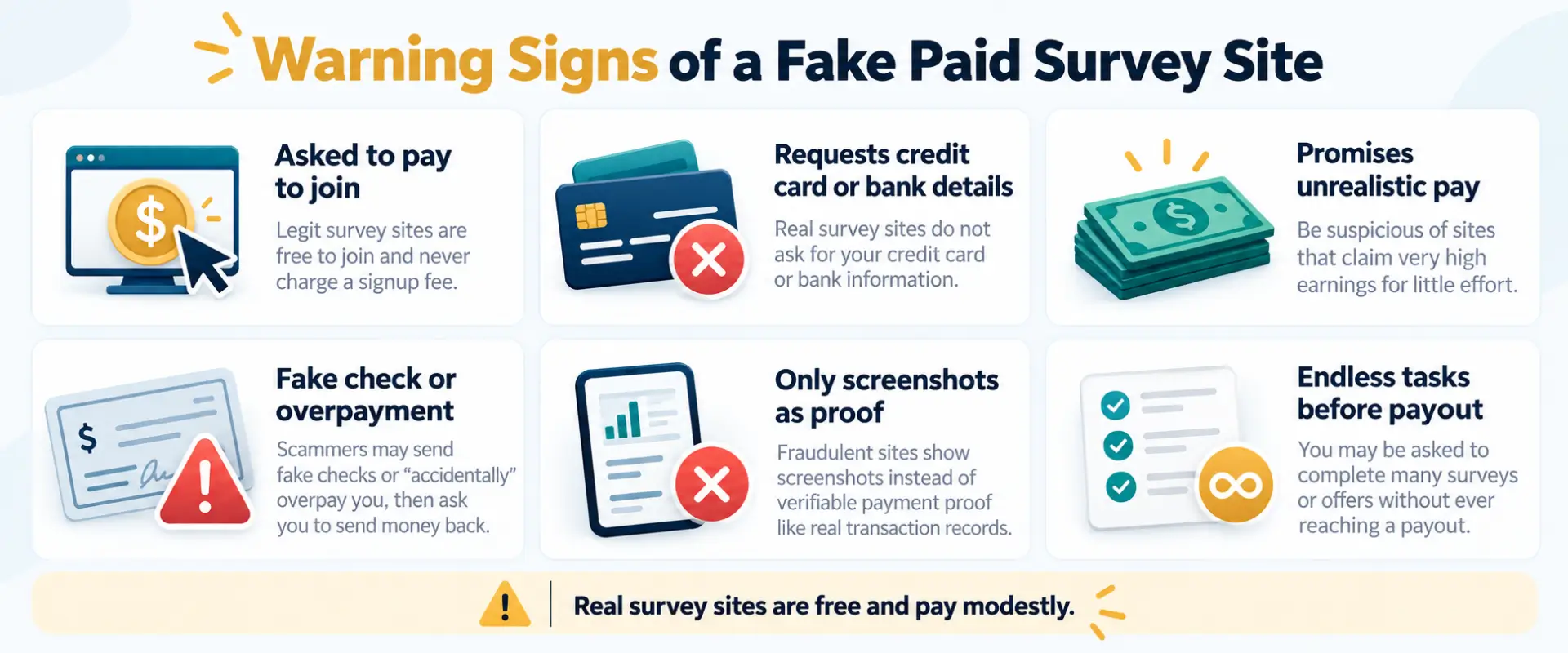
Legitimate survey sites are free and pay modestly. Scams do the opposite. They’re loud about money and quiet about how you’ll get it. ⚠️ Watch for these:
- You’re asked to pay to join, or to get “premium” survey access. Never pay to take surveys.
- They want sensitive details up front. Credit card numbers, bank passwords, or a Social Security number have no place in a survey. The FTC has warned that real surveys don’t need your card details to deliver a “free” reward.
- The pay is too good. $50 or $100 for a five-minute survey, or “$300 a day,” isn’t how this industry works.
- A check shows up with an overpayment. If you’re told to deposit it and send back the difference, that’s a classic fake-check scam.
- The proof is a screenshot. Payout screenshots and glowing testimonials are easy to fake.
- You never reach the payout. Endless required surveys before the first payment is a bad sign.
Not sure about a particular site? Start with our guide on whether paid online surveys are legit. The Minnesota Attorney General’s office also publishes a clear guide to survey scams, and if you’ve already been burned, you can report it at ReportFraud.ftc.gov.
Do you have to pay taxes on survey earnings?
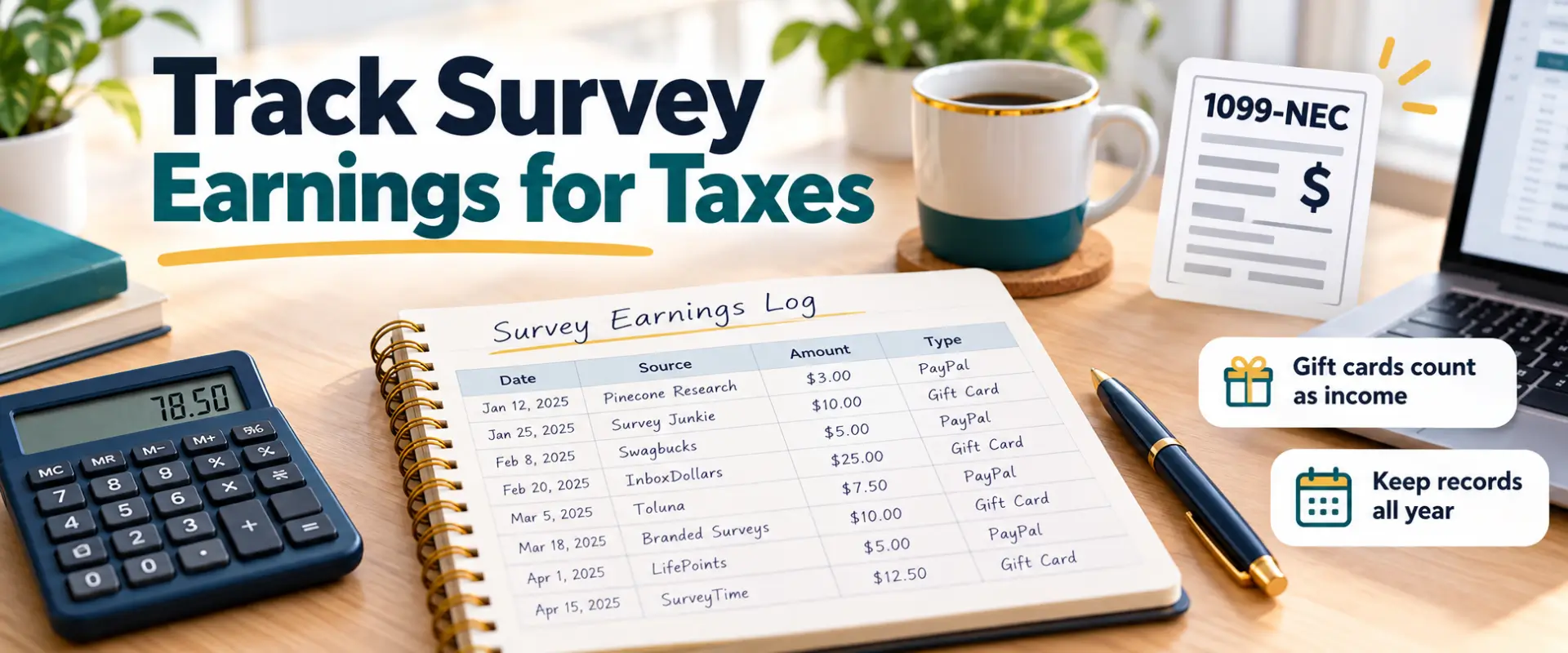
Usually, yes. Survey rewards count as income. That includes gift cards, because the IRS treats them like cash, so a $20 gift card is $20 of income.
There’s one change worth knowing about. For payments made starting in 2026, the amount at which companies must send you a 1099-NEC or 1099-MISC rose from $600 to $2,000. But that threshold only decides whether you receive a form. You’re still expected to report the income even if no form arrives.
The easy fix is a simple log with the date, the source, and the amount, kept all year. The IRS explains what counts as income in Publication 525, and if your total starts to grow, a tax professional can tell you what applies to your situation. This is general information, not tax advice.
5 ways to make paid surveys pay a little better
You can’t turn surveys into a salary. You can stop losing money to avoidable mistakes.
- Finish your profile, and keep it honest. A complete profile gets you matched with more surveys. Inconsistent or made-up answers get accounts flagged and closed.
- Stick to a few reputable sites. Two to four is plenty. Twenty accounts just means twenty inboxes to babysit.
- Answer invitations quickly. Quotas fill fast, and an invite that’s open at 9 a.m. may be gone by lunch.
- Track your real hourly rate for a week. Write down minutes spent and dollars earned. If a site keeps paying under 5 cents a minute, drop it.
- Say yes to better-paying formats. When a site invites you to a product test, interview, or focus group, those usually beat a standard survey by a wide margin.
For a closer look at what’s realistic once you’ve set things up, see our post on realistic survey earnings.
Do paid surveys really pay? Quick answers to common questions
Can you really make money from paid surveys?
Yes. Legitimate survey sites pay members in cash, points, or gift cards for completed surveys. The amounts are small, usually $0.50 to $3 per survey, so it works as extra pocket money rather than income you can plan around.
How much can you make from paid surveys in a day?
Most people earn a few dollars a day. At $2 to $4 an hour, one hour of surveys brings in $2 to $4, and a $10 day usually takes several hours plus a lucky run of invitations.
Can you make $100 a day from paid surveys?
Not from standard surveys. At $3 an hour you’d need about 33 hours of survey time in a single day. Higher figures usually involve focus groups, interviews, or product tests, which pay better but are offered far less often.
Do real paid surveys ask for money or bank details?
No. Legitimate survey sites never ask you to pay, and they don’t need your bank password or card number to give you a reward. If a survey asks for either, close it.
Which pays more, surveys or focus groups?
Focus groups and interviews pay far more per hour, often tens of dollars per session or more, but invitations are rare and screening is strict. Standard surveys pay less but are available more often, which is why many people use both.
So, do paid surveys really pay enough to be worth it?
They’re worth it for a specific kind of person with a specific kind of time. If you’ve got ten spare minutes in a waiting room, a survey beats scrolling, and you might end the month with enough for a gift card. If you’re hoping for rent money, you’ll be disappointed, and the disappointment is expensive because you pay for it in hours.
Start small. Pick one reputable site, finish the profile honestly, and write down your minutes and dollars for a single week. Those notes will tell you more than any review, this one included. Then decide if it’s worth continuing.
If you’re brand new, begin with how paid online surveys work so you know what you’re signing up for.
Note: Earnings examples in this article are illustrative. Your results depend on your profile, your time, and the platforms you use. This article is general information, not tax or financial advice.